≥99% PURITY GUARANTEEDTHIRD-PARTY TESTEDSAME-DAY SHIPPING USAFREE SHIPPING $200+
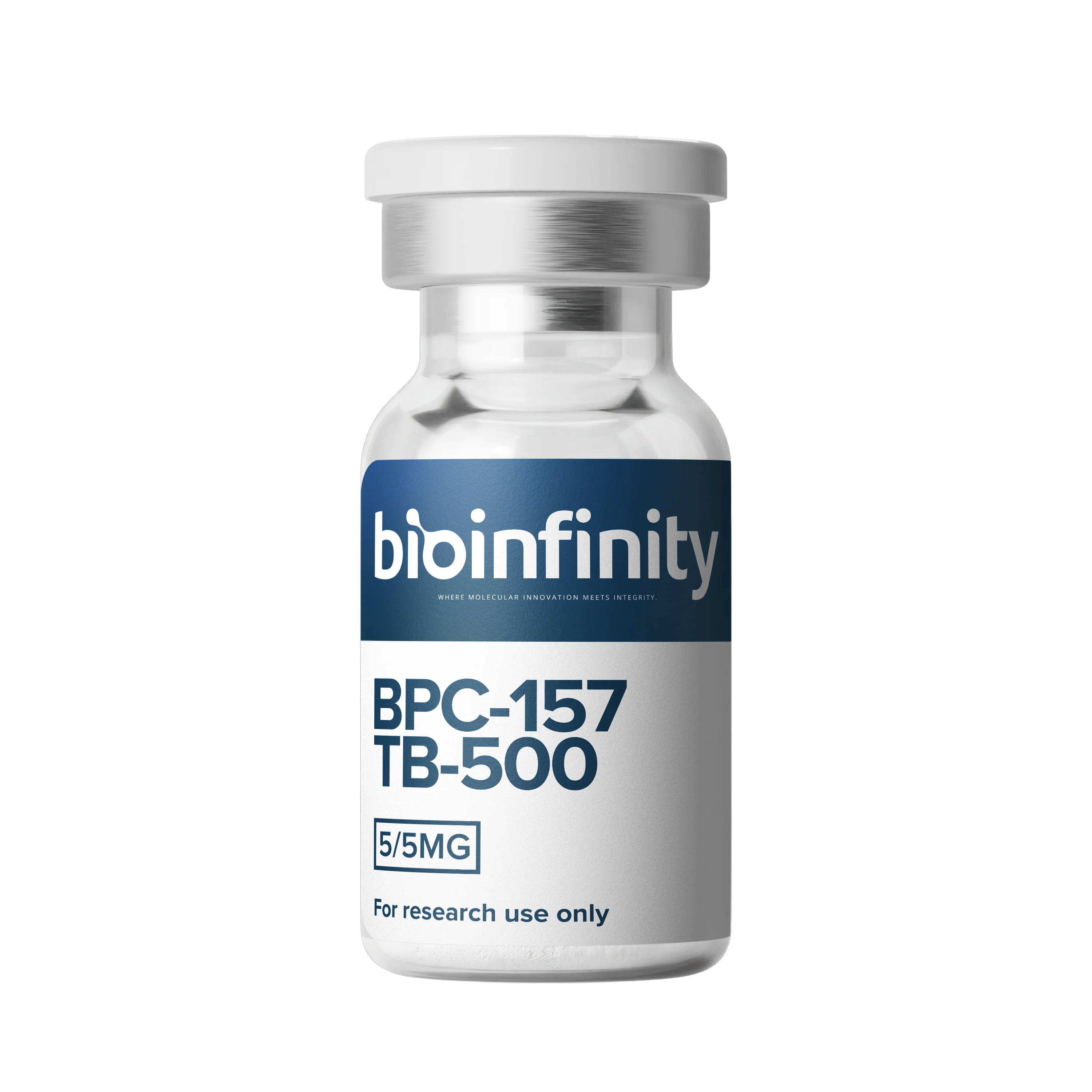
BLENDBPC-157 & TB-500 - 10 mg (5/5)
Recovery & Repair

BPC-157 & TB-500

Dual-peptide blend of BPC-157 + TB-500 — the go-to recovery and tissue-repair stack.

$90.00
99.92% Purity Verified

Third-Party Tested by Verum Analytics

Batch: BIL-BB20-01-2602Feb 4, 2026
+99% Purity
Third-Party Tested
COA Available
16 sold in the last 24 hours
Order in 0h 0min for same-day shipping
Buy More, Save More
QuantityPrice
Add 2 more for 15% off
$90.00
Albert - Chief Researcher

Albert's Verdict

This is the blend I'd reach for first in any wound-model research design. BPC-157 handles the vascular and inflammatory signaling while TB-500 drives cellular migration and reorganization — they operate on complementary mechanisms without redundancy.

View COA

Out of Stock

Arrives as lyophilized (powder) form

Shipped freeze-dried for maximum stability and shelf life. See laboratory preparation guide for handling instructions.

Secure Checkout256-bit SSL
99%+ PurityThird-Party Verified
Same-Day ShippingOrder by 2PM EST
Satisfaction Guarantee

Product Description

This research blend combines the two most widely studied peptides for recovery and healing into a single vial. BPC-157 (Body Protection Compound-157) drives local tissue repair, angiogenesis, and gut protection, while TB-500 (Thymosin Beta-4 fragment) acts systemically to promote cell migration, muscle regeneration, and reduction of inflammation.

Together, BPC-157 + TB-500 is the most popular stack for research into tendon, ligament, and muscle injury recovery, with users often citing complementary local + systemic effects. For research use only. Not for human or veterinary consumption.

Technical Specifications

Molecular Formula
C62H98N16O22 + C212H350N56O78S
Molecular Weight
1419.53 + 4963.5 g/mol

Frequently Researched Together

Commonly studied alongside in laboratory settings

Bundle total (3 items):$182.00

Verified reviews — BPC-157 & TB-500

5 verified buyers

5.0 / 5
Vin S.Verified buyer
Jun 14, 2026
Quick shipping

Product arrived fast and secured in a vial case with bubble wrap.
Justin riegel J.Verified buyer
Jun 12, 2026
Works good

Had pain in my elbow for months this help heal it in a couple weeks

Scott P.Verified buyer
Jun 12, 2026
excellent product

arrived as promised. great quality with great reconstitution .

Becky W.Verified buyer
Jun 12, 2026
exceptional peptide.

This peptide definitely lives up to the hype! Excellent purity, fast shipping and very effective! Made a huge difference after several weeks of consistent with no side effects. Placing double the order next time. Trust worthy source.

Holly F.Verified buyer
Jun 11, 2026
fast results

i have been dealing with a torn acl for months/ for me ,surgery wasnt an option . 4 weeks of bc-157/ tb 500// the results are amazing/ well on my to a full recovery/ this is amazing

Reviews are submitted by verified buyers via per-order tokenized links. Reviews are evaluated for product-focused content; any review containing therapeutic claims (cured, treats, healed, etc.) may be edited or hidden to maintain compliance with FDA and platform guidelines.

Research Use Only: This product is intended for laboratory research purposes only. Not for human consumption.

Research summary

BPC-157 — clinical & mechanistic profile

BPC-157 is a synthetic 15-amino-acid peptide derived from a gastric protective protein. As of 2026, only 3 published human studies exist (all pilot-scale with <30 subjects), but 500+ preclinical studies show tissue healing effects. A 2025 IV safety study (up to 20mg) in healthy adults showed no adverse events across cardiac, hepatic, and renal biomarkers.

Research status

preclinical

Sequence

Gly-Glu-Pro-Pro-Pro-Gly-Lys-Pro-Ala-Asp-Asp-Ala-Gly-Leu-Val

Molecular weight

1419.53 Da

Molecular formula

C62H98N16O22

Studied applications

  • Tissue repair pathways: studied in tendon, ligament, and muscle injury models with histological and biomechanical endpoints
  • Vascular and NO signaling: investigated for effects on microcirculation and endothelial behavior in stress and injury contexts
  • Protective signaling: examined in gastrointestinal, neural, and systemic injury models across multiple organ systems
  • Fibroblast activity: associated with extracellular matrix remodeling and cell migration in connective tissue models
  • Gastrointestinal integrity: studied in gastric ulcer, IBD, and intestinal anastomosis models for mucosal protection
  • Central nervous system: explored in nerve injury and neurodegenerative disease models in rodents

Mechanisms of action

  • VEGF and angiogenesis: upregulates VEGF expression in vivo, activates VEGFR2 receptors on endothelial cells, triggers Akt-eNOS pathway phosphorylation
  • Nitric oxide modulation: enhances endothelial NOS (eNOS) activity via Src-Cav-1-eNOS pathways, influences NO synthase activity and vascular tone
  • Cell migration signaling: modulates FAK (focal adhesion kinase) and paxillin pathways affecting cell migration and adhesion
  • Growth hormone receptor: boosts GHR expression in tendon fibroblasts, enhancing collagen synthesis in rodent studies
  • ERK1/2 phosphorylation: activates downstream targets (c-Fos, c-Jun, Egr-1) promoting cell growth and migration
  • Cytoprotective action: functions as membrane stabilizer and free radical scavenger in controlled studies
Research constraints & safety notes
  • No completed human clinical trials establishing safety or efficacy - majority of evidence is preclinical (in vitro and animal models)
  • Preclinical findings do not establish clinical efficacy in humans and should be interpreted within experimental model limitations
  • Research originates predominantly from a limited number of research groups, with variable independent replication
  • Not approved by FDA, EMA, or any regulatory agency for therapeutic, medical, or supplemental use in humans
  • Classified as Category 2 bulk drug substance by FDA (2023) - cannot be compounded by commercial pharmaceutical companies

Peer-reviewed references

  1. Sikiric P, et al. — BPC 157: A Review of its Molecular Mechanisms (2019)PMID: 30915550View
  2. Chang CH, et al. — GH receptor expression in tendon fibroblasts (2011)PMID: 21030672View
  3. Vukojevic J, et al. — NO system interaction in vascular stress models (2011)PMID: 21842328View
  4. Sikiric P, et al. — Skin wounds, colon anastomoses, angiogenesis (1997)PMID: 9403790View
  5. Sikiric P, et al. — Multi-species preclinical safety evaluation (2020)PMID: 32334036View

For research use only. This summary is a research-scientific overview compiled from peer-reviewed sources. It is not medical advice and is not intended for human or veterinary consumption.