
The Mot-C lived up to my expectations and then some! There was a bit of a shipping mix up and I can’t say enough about the great and responsive customer service. The folks at Bioinfinity have my business!

Third-Party Tested by Verum Analytics
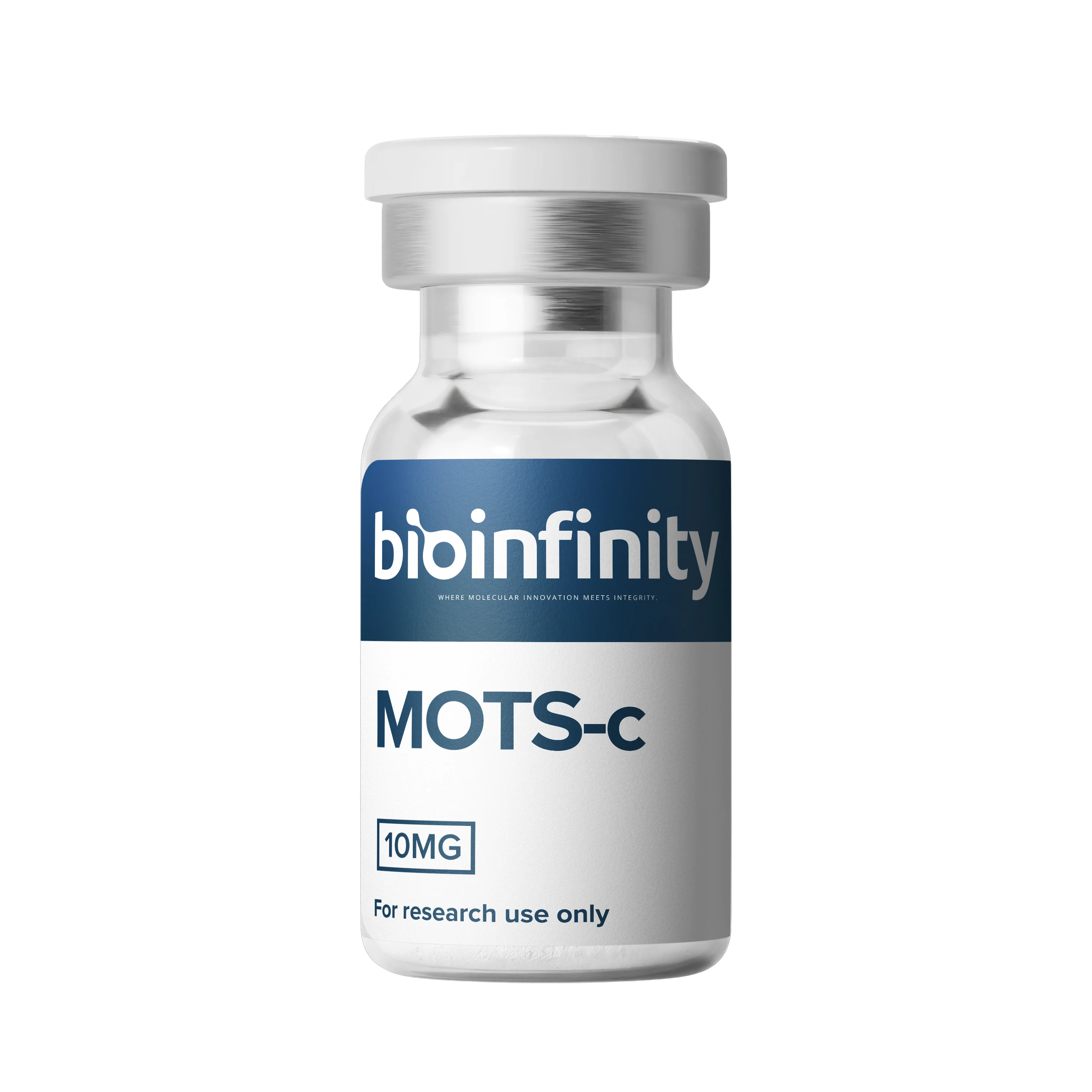
MOTS-c
Mitochondrial-derived exercise-mimetic peptide — insulin sensitivity, fat oxidation, and longevity research.
Third-Party Tested by Verum Analytics

Albert's Verdict
MOTS-c is the only mitochondrial-derived peptide I know of that translocates to the nucleus under metabolic stress — it's essentially your mitochondria sending an SOS that triggers whole-body adaptation. The insulin sensitivity data at 12 weeks is hard to ignore.
View COA✓ In stock - Ships same day
Arrives as lyophilized (powder) form
Shipped freeze-dried for maximum stability and shelf life. See laboratory preparation guide for handling instructions.
Product Description
MOTS-c is a 16-amino-acid peptide encoded within the mitochondrial genome (the mitochondrial open reading frame of the 12S rRNA type-c). It acts as a mitohormone, regulating metabolic homeostasis and behaving as a natural exercise-mimetic — enhancing glucose uptake, fat oxidation, and AMPK activation even in the absence of exercise.
Research has documented improved insulin sensitivity, enhanced glucose metabolism, and effects on pancreatic islet cell senescence. MOTS-c levels naturally decline with age (but remain stable in long-lived species like naked mole rats), making it a prime candidate in metabolic longevity research. For research use only. Not for human or veterinary consumption.
Technical Specifications
- Molecular Formula
- C101H152N28O22S2
- Molecular Weight
- 2174.64 g/mol
- Sequence
- Met-Arg-Trp-Gln-Glu-Met-Gly-Tyr-Ile-Phe-Tyr-Pro-Arg-Lys-Leu-Arg
Frequently Researched Together
Commonly studied alongside in laboratory settings
Verified reviews — MOTS-c
4 verified buyers
Excellent Service
Top of the line company, product purity second to none.
As advertised, Bioinfinity lab is my go to source for all peptides. Always have been consistent in purity and fast shipping.
Reviews are submitted by verified buyers via per-order tokenized links. Reviews are evaluated for product-focused content; any review containing therapeutic claims (cured, treats, healed, etc.) may be edited or hidden to maintain compliance with FDA and platform guidelines.
Learn More About This Peptide
Research Use Only: This product is intended for laboratory research purposes only. Not for human consumption.
MOTS-c — clinical & mechanistic profile
MOTS-c is a 16-amino-acid mitochondrial-derived peptide encoded within the 12S rRNA gene. 2025 studies show it restores cardiac mitochondrial OXPHOS respiration and reduces fasting glucose/hypertrophy in T2D rat models, protects against acute lung injury, and delays weight gain in high-fat diet models. Analog CB411 shows superior stability for obesity/NASH. Levels decline 21% in elderly vs young adults.
Research status
preclinical
Sequence
MRWQEMGYIFYPRKLR
Molecular weight
2174.64 Da
Molecular formula
C101H152N28O22S2
Studied applications
- •Exercise mimetic: causes cells to behave as if exercise has occurred, with older mice doubling running capacity on treadmill tests
- •AMPK activation: potent activator of the 'metabolic master switch' AMP-activated protein kinase, increasing glucose uptake and fat burning
- •NAD+ and sirtuin elevation: increases NAD+ levels and activates SIRT1, metabolic cofactors critical for cell survival and energy metabolism
- •Insulin sensitivity: improves glucose uptake and insulin responsiveness in muscle and adipose tissue
- •Folate-methionine regulation: modulates folate and methionine metabolism, pathways connected to DNA methylation and cellular stress
- •Longevity association: centenarians maintain higher MOTS-c levels than shorter-lived peers; levels decline 21% in 70-81 year olds vs 18-30 year olds
Mechanisms of action
- •AMPK pathway activation: directly activates AMP-activated protein kinase in skeletal muscle, triggering metabolic adaptations and glucose uptake
- •NAD+/SIRT1 activation: elevates NAD+ levels and activates sirtuins (particularly SIRT1), critical metabolic cofactors for cell survival
- •Nuclear translocation: unique ability to travel to nucleus and influence gene expression related to metabolism via ARE/TFAM pathways
- •Glucose metabolism: enhances glucose uptake in muscle and adipose tissue, improving whole-body glucose homeostasis
- •Fatty acid oxidation: promotes lipid catabolism and reduces fat accumulation through metabolic gene activation
- •Methionine restriction mimetic: promotes methionine restriction effects (which extends mouse lifespan by 45% and reduces age-related diseases)
- •Most data from rodent models—human translation not established
- •Endogenous production declines with age, complicating supplementation logic
- •Optimal dosing and administration routes for research not standardized
- •Long-term effects of exogenous MOTS-c administration unknown
- •Not FDA approved for any therapeutic use
Peer-reviewed references
- Lee C, et al. — Original MOTS-c discovery and metabolic effects in Cell Metabolism (2015)PMID: 25738459View
- Reynolds JC, et al. — MOTS-c exercise and aging study (2019)PMID: 30948516View
- Kim SJ, et al. — MOTS-c and metabolic homeostasis reviewPMID: 33037436View
- Mitochondrial-derived peptides cellular functionsPMID: 27239947View
- MOTS-c in skeletal muscle metabolismPMID: 32958710View
For research use only. This summary is a research-scientific overview compiled from peer-reviewed sources. It is not medical advice and is not intended for human or veterinary consumption.