thesaintnoahVerified buyer
Jun 8, 2026
★★★★★
Exceptional fast shipping and Customer Service
Amazing product, BioInfinity is the only place i am going to use in the future, thanks for the amazing customer service you are providing!
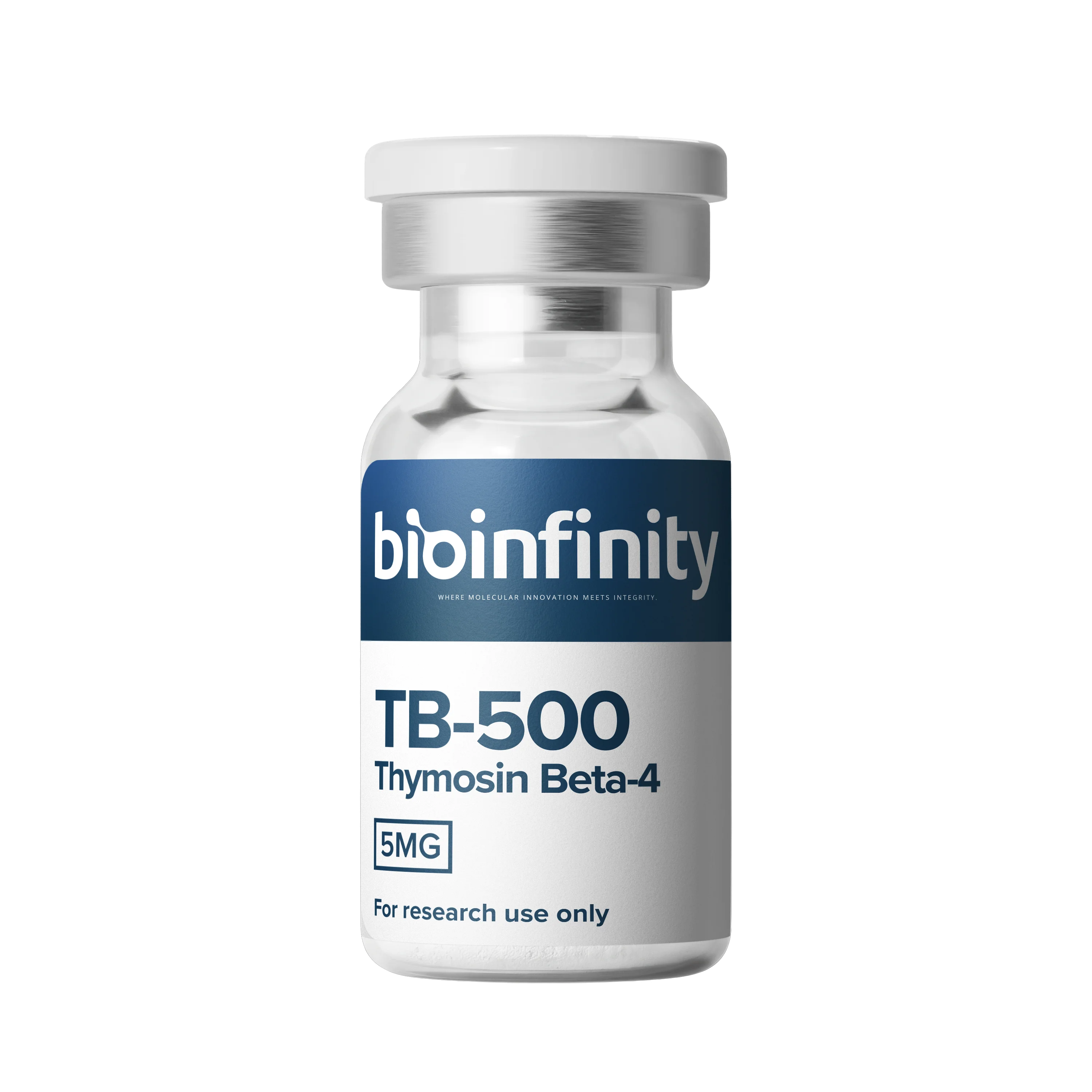
Third-Party Tested by Verum Analytics
Thymosin Beta-4 fragment — systemic tissue repair, cell migration, and full-body recovery peptide.
Third-Party Tested by Verum Analytics

Albert's Verdict
Thymosin Beta-4's actin-binding mechanism is what makes it exceptional — it drives how tissue reorganizes in wound-model research. The migration data on endothelial cells is some of the most consistent I've reviewed.
View COA✓ In stock - Ships same day
Arrives as lyophilized (powder) form
Shipped freeze-dried for maximum stability and shelf life. See laboratory preparation guide for handling instructions.
TB-500 is a synthetic 7-amino-acid fragment (Ac-LKKTETQ) corresponding to the active actin-binding region of Thymosin Beta-4 (Tβ4), a protein that plays a central role in cell migration, tissue repair, and angiogenesis. Compared to the parent peptide, TB-500 is more stable and more practical for research use.
Studied for accelerated healing of muscles, tendons, ligaments, and organs. Unlike locally-acting peptides such as BPC-157, TB-500 acts systemically — delivering full-body regenerative support. Frequently stacked with BPC-157 for the most-referenced recovery and tissue-repair protocol in peptide research. For research use only. Not for human or veterinary consumption.
TB-500 is a synthetic version of Thymosin Beta-4, a naturally occurring 43-amino acid peptide found in high concentrations in blood platelets, wound fluid, and other tissues. Thymosin Beta-4 was originally isolated from thymus extracts in the 1960s and has since been identified as a major actin-sequestering protein with significant roles in cell migration, differentiation, and cellular pathway. TB-500 represents a truncated, active region of the full Thymosin Beta-4 molecule, making it more practical for research applications while retaining the key biological activity associated with the parent molecule.
TB-500's biological effects stem from several well-characterized mechanisms that have been studied extensively in laboratory and preclinical settings:
Actin Sequestration: TB-500's primary function involves binding to G-actin (monomeric actin), preventing its polymerization into F-actin filaments. This regulation of actin dynamics is crucial for cell motility and morphological changes during cellular pathway.
Cell Migration Promotion: By modulating the actin cytoskeleton, TB-500 promotes cell migration—a critical process in wound-model research, angiogenesis, and cellular-pathway research. Research shows enhanced migration of endothelial cells, keratinocytes, and other cell types.
Angiogenesis Stimulation: Studies demonstrate TB-500's ability to promote new blood vessel formation. This involves upregulation of VEGF and other angiogenic factors, along with direct effects on endothelial cell proliferation and migration.
Inflammatory Pathway Research: Research indicates TB-500 may modulate cytokine expression and inflammatory cell activity in laboratory studies. Studies show altered expression of inflammatory markers in various experimental models.
Stem Cell Recruitment: Some research suggests TB-500 may influence the mobilization and differentiation of stem and progenitor cells, potentially contributing to its observed cellular-pathway effects.
TB-500/Thymosin Beta-4 has been extensively studied in cardiac research. Studies in animal models of myocardial infarction have shown reduced scar formation, improved cardiac function, and enhanced survival of cardiomyocytes. Clinical trials have explored its potential in cardiac cellular-pathway research following heart attack.
Significant research has focused on TB-500's effects on corneal healing. Studies demonstrate accelerated corneal wound closure, reduced inflammation, and improved outcomes in various corneal injury models. This research led to clinical development of Thymosin Beta-4-based eye drops.
Research has examined TB-500's effects on skin wounds, including burns, incisions, and chronic wounds. Studies report accelerated wound closure, enhanced epithelialization, improved collagen organization, and reduced scarring in various experimental models.
Preclinical studies have investigated TB-500's effects on muscle, tendon, and ligament injuries. Research shows potential benefits for muscle strain recovery, tendon healing, and joint health, with observations of reduced inflammation and accelerated cellular pathway.
| Molecular Formula | C₂₁₂H₃₅₀N₅₆O₇₈S |
| Molecular Weight | 4963.44 g/mol |
| Sequence | Ac-SDKPDMAEIIEKFDKSKLKKTETQEKNPLPSKETIEQEKQAGES (43 AA) |
| Purity | ≥99% (HPLC verified) |
| Form | Lyophilized powder |
| Appearance | White to off-white powder |
| Solubility | Soluble in water, bacteriostatic water |
| Storage | -20°C (lyophilized), 2-8°C (reconstituted) |
TB-500 is a synthetic peptide based on Thymosin Beta-4, a naturally occurring protein involved in cell migration and cellular pathway research. It consists of 43 amino acids and has been studied for its potential healing and cellular-pathway properties.
Explore our comprehensive research guides for detailed information on peptide handling, storage, and research protocols.
Verified research purchases
Been searching for a reliable supplier for months. The purity is legit - you can verify it yourself on the lab's website. Shipped fast and arrived cold. Will definitely reorder.
This is my go-to source now. Consistent quality every time, and the customer service actually responds when you have questions. The quantity discounts are a nice bonus too.
After trying 3 different suppliers, this one stands out. The COA is verifiable, shipping is fast, and the product quality speaks for itself. Highly recommend.
Ordered before 2PM and it shipped the same day. Package arrived in perfect condition with ice packs still frozen. That's how it should be done.
You get what you pay for. The third-party testing and COA verification gives me confidence. Already placed my second order.
Love that I can verify the COA directly on Verum's website. The full analytical report with HPLC chromatogram checked out. This level of transparency is rare.
Proper packaging, cold shipping, and everything documented. You can tell they take quality seriously. Already recommended to friends.
Commonly studied alongside in laboratory settings
Frequently asked questions about this compound for laboratory researchers.
Peer-reviewed literature relevant to TB-500 research. Linked PubMed IDs open the original source.
1 verified buyer
Amazing product, BioInfinity is the only place i am going to use in the future, thanks for the amazing customer service you are providing!
Reviews are submitted by verified buyers via per-order tokenized links. Reviews are evaluated for product-focused content; any review containing therapeutic claims (cured, treats, healed, etc.) may be edited or hidden to maintain compliance with FDA and platform guidelines.
Research Use Only: This product is intended for laboratory research purposes only. Not for human consumption.
TB-500 is a synthetic 7-amino-acid fragment from thymosin beta-4's actin-binding site. A Phase 1/2 trial launched February 2026 investigates its cardiovascular effects in adults with stable atherosclerotic disease. Phase 1 safety data in 84 healthy volunteers showed favorable tolerability. 2025 research reveals its wound-healing activity may stem from the metabolite Ac-LKKTE rather than the parent compound.
Research status
clinical investigational
Sequence
Ac-LKKTETQ (active fragment of 43-aa Tβ4)
Molecular weight
4963 Da (full Tβ4) / ~900 Da (TB-500 fragment)
Molecular formula
C212H350N56O78S (full Tβ4)
For research use only. This summary is a research-scientific overview compiled from peer-reviewed sources. It is not medical advice and is not intended for human or veterinary consumption.