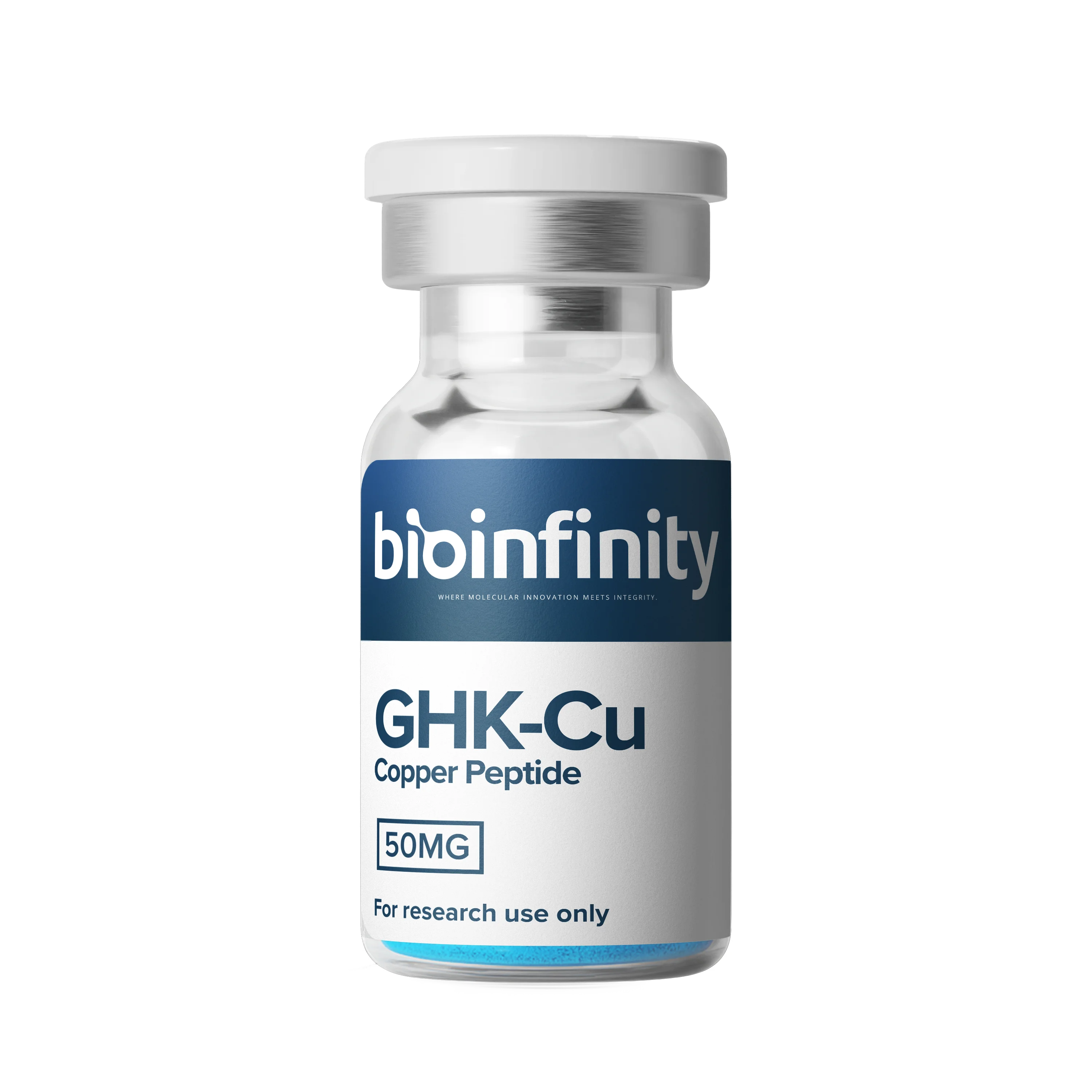
What GHK-Cu is
GHK-Cu is a naturally occurring copper-binding tripeptide that regulates over 4,000 genes involved in peptide research, collagen synthesis, and anti-inflammatory responses. 2025-2026 research confirms it delivers bioavailable copper, resets cellular gene expression to a younger-marker state, reduces IL-6/TNF-alpha, supports DNA repair via 84 anti-cancer-related genes, and shows cumulative collagen remodeling with 3-6 months of use. It has a molecular formula C14H24N6O4Cu (copper complex), mass 340.38 Da (free peptide) / 401.93 Da (copper complex) Da. Its published amino-acid sequence is Gly-His-Lys. Common synonyms in the literature include Copper Peptide GHK, GHK Copper, and Glycyl-L-histidyl-L-lysine copper.
What it's studied for
Investigation of GHK-Cu to date is clinical-investigational, with the majority of citations concentrated in animal models and in-vitro assays rather than randomized controlled human trials. Published work referencing GHK-Cu spans Topical wound healing: Extensive research has examined GHK-Cu in dermal wound models, showing effects on reepithelialization, collagen deposition, and wound closure. GHK-Cu superiority over GHK alone has been demonstrated in murine wounds, with effects requiring Cu²⁺ (abolished by chelators like bathocuproine), Skin aging and cosmetic research: Studies have investigated GHK-Cu for effects on photoaging, dermal collagen research, skin thickness, and elasticity. Most human data comes from cosmetic product studies rather than rigorous clinical trials, and Gene expression studies: Microarray analyses have shown GHK-Cu modulates expression of over 4,000 genes, with structural genes upregulated and inflammatory/damaging genes downregulated. Key affected pathways include TGF-β signaling, DNA repair, and antioxidant systems. Proposed mechanisms in the literature include Copper delivery: forms stable complex with Cu²⁺ (binding constant log10 ≈ 16.44), delivering copper while silencing redox toxicity and Gene expression: upregulates structural genes (TGF-β pathway) and downregulates inflammatory genes (IL-6, fibrinogen). None of this material describes therapeutic outcomes in humans, and BioInfinity does not sell, market, or provide dosing guidance for GHK-Cu outside laboratory research.
Laboratory handling — storage and reconstitution
Lyophilized GHK-Cu arrives as a fluffy off-white solid inside a sealed sterile vial. Because it ships as a lyophilized peptide (340.38 Da (free peptide) / 401.93 Da (copper complex) Da), the powder is best stored between 2–8 °C prior to reconstitution and returned to −20 °C in aliquots for long-term storage post-reconstitution. Reconstitution is typically performed with bacteriostatic water (0.9 % benzyl alcohol preserved) rather than sterile water because the preservative extends solution stability once the vial has been punctured. Warming the reconstituted solution to room temperature before drawing helps redissolve any peptide that has settled against the vial wall. Avoid repeated freeze–thaw cycles: for peptides in this molecular-weight range (340.38 Da (free peptide) / 401.93 Da (copper complex) Da), freeze–thaw stress is one of the most common causes of loss-of-purity between batches.
How this batch is verified
Every batch of GHK-Cu ships with a batch-specific Certificate of Analysis produced by an ISO-accredited third-party analytical laboratory. Reversed-phase HPLC confirms the assay against the expected 340.38 Da (free peptide) / 401.93 Da (copper complex) Da mass (C14H24N6O4Cu (copper complex)); mass spectrometry validates the exact monoisotopic mass; endotoxin (LAL) testing confirms bacterial-contamination limits appropriate for laboratory research; and residual-solvent panels confirm the manufacturing pipeline. The lot number on the outer label matches the COA on the public /coa-library page — every purity claim is independently verifiable before you open the vial.
Related research
For the full mechanistic profile, published references, and constraint notes on GHK-Cu, see the GHK-Cu research page. All references cited on that page are peer-reviewed primary literature.
Research use only. GHK-Cu is sold strictly for in-vitro and animal research. It is not a drug, food, supplement, or cosmetic and is not intended for human or veterinary consumption. No statements on this page describe or imply any therapeutic effect.